
At PointClear, we’re often asked to help our clients with their product roadmap and defining the features of their Minimum Viable Product (MVP). While this approach has served us well in the past, to achieve success in today’s consumer-driven, app-focused world, a different approach is needed. An approach that centers on a user experience roadmap, rather than a product roadmap.
In previous blog posts, I’ve written about the importance of using various research methods to gain empathy for your users – to help ensure their needs are at the center of your software design process from start to finish. Today, I want to explore how these insights into your users’ primary goals and tasks should be used to prioritize your user experience roadmap and help define the product you ultimately create.
Let’s begin by talking MVP. While MVP can mean different things to different people, I define it as the smallest thing you can build that delivers user value and allows you to go through the build-measure-learn feedback loop. When building your UX roadmap and defining your MVP iterations, there are two critical things to remember to assure you are building a product that results in a positive end-user experience:
- Each MVP iteration should consider the entire end-to-end user experience of completing key tasks.
- Your end users’ goals should be top-of-mind when defining each MVP iteration.
Two Critical Things: Digging Deeper
Often times, an MVP is thought of as a set of specific features. But, if you consider that a user flow is a series of steps that need to be taken to complete a task in your product, the limitation of defining an MVP as a set of features is that features are often just one step along a user’s path. Instead, consider defining your MVP by key task flows to allow focus on a quality end-to-end experience, even if it is heavily restricted to only a “single path” in the beginning.
For example, let’s say you’re building a wellness app that allows users to track their exercise, earn badges based on achievements, view progress over time, and interact with family and friends. If you focus your MVP on a set of features – say the ability to track exercise – your team becomes consumed with the need to support all types of exercise (walkers want to track steps, swimmers want to track laps, runners want to track distance, weight lifters want to track reps, and so on). The time spent trying to support all variations on exercise, while important, leaves little or no time to focus on other features along the user experience path.
An alternative approach for defining your first MVP iteration would be to build a way to log exercise, based on number of minutes, to support various forms of exercise. Then, focus on rewarding users for their exercise with a single type of badge, display this progress over time, and allow users to share their achievement with friends. Focus on a good end-to-end experience for MVP. Then, for your next iteration, come back and create variants of exercise tracking and extend the reward and social components, as well. This approach creates a version of your product that allows you to demonstrate total potential value and gain feedback on all aspects of your product.
Said Another Way…
A few years ago, there was much discussion in the agile and lean development communities when Spotify’s Henrik Kniberg shared the following visual to illustrate how best to go about building an MVP.
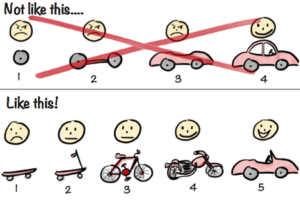
Kniberg shows two alternative approaches for creating a mode of transportation in incremental stages. The top row is an example of creating an MVP one feature at a time – first a wheel, next the drive train, then the body, and finally a complete car. Early on, the product team decides that a car is the final solution. The incremental stages are based on ways to effectively engineer a car.
The bottom row, however, is an example where each iteration of the MVP maintains focus of the end user’s goal of getting from Point A to Point B. The product at the first stage is a skateboard and slowly evolves into a better performing mode of transportation. Although the early iterations may not completely satisfy the user, the team continuously builds something that works toward the ultimate goal.
Team Skateboard is at an advantage, because they have a testable product at the end of each stage and can measure how well their product – as a mode of transportation – performs. Their approach allows for validation at each stage to obtain feedback and improve the system. It gives them the flexibility to pivot, as needed, and insight into which features should be prioritized in their backlog (which helps when defining the next iteration of their product). In contrast, Team Car’s strategy is based on a gamble that a car is the final solution.
Getting from Point A to Point B
Some criticize Kniberg’s argument, stating that if the goal is to build a car, the first approach is the more efficient way to go about it. But, the point Kniberg is making is that the user’s goal is not, “I want a car,” but rather, “I want a way to travel from Point A to Point B”. Yes!
The takeaway for software designers: While your end users can often tell you about a problem they have, they can seldom tell you exactly how to solve it. More often than not, it takes them being able to see and use something (i.e. interacting with prototypes) before they can give the kind of quality feedback needed to shape the ultimate solution (i.e. your product).
To this point: What if after interacting with a bicycle, the team learns that the solution must accommodate many passengers. The product direction can shift towards building a bus. Or perhaps they gain insights that lead them in the direction of building a boat or an airplane. Staying focused on the user’s end goal and going through build-measure-learn loops will uncover insights that will help you build the product(s) your customers want and need.
In the End…
Ultimately, this user-centric approach to roadmapping and MVP iteration is how delight features will begin to make their way off of your backlog and into production, allowing you to improve and up-level your product over time.
No comments.